

System Architecture Overview
ORISO Platform v3.0.0 is a comprehensive online counseling platform deployed on Kubernetes using Helm charts. The platform consists of 21 services organized into deployment phases.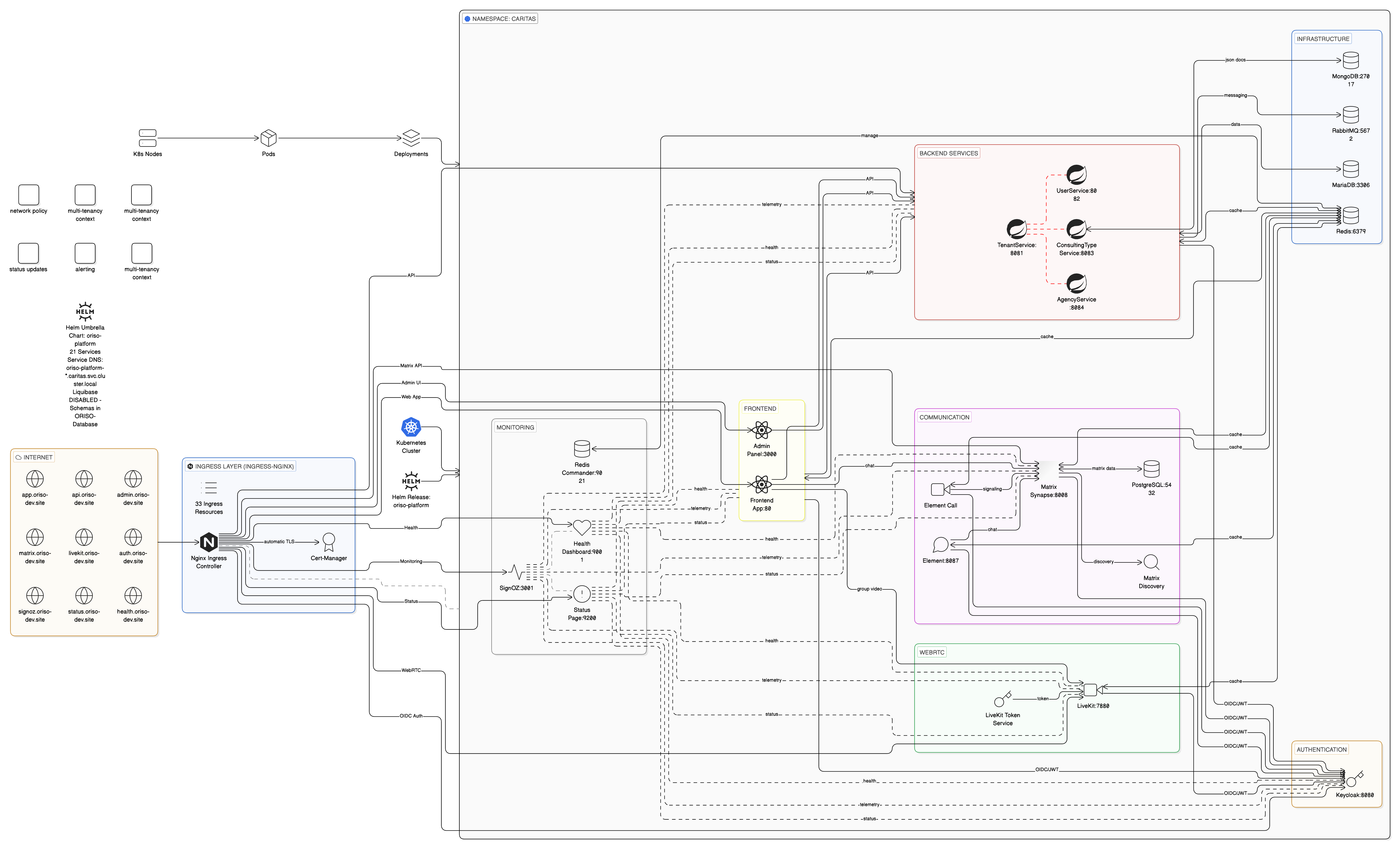
If the diagram appears large, scroll horizontally on smaller screens.
Architecture Highlights
Deployment Model
- Platform: Kubernetes (k3s recommended)
- Package Manager: Helm 3.x
- Deployment Method: Umbrella Helm chart (
oriso-platform) - Namespace:
caritas - Service Discovery: Kubernetes DNS (
.svc.cluster.local)
Service Naming Convention
All services use theoriso-platform-* prefix:
oriso-platform-userservice.caritas.svc.cluster.local:8082oriso-platform-agencyservice.caritas.svc.cluster.local:8084oriso-platform-mariadb.caritas.svc.cluster.local:3306
Deployment Phases
The platform is deployed in the following order:Phase 1: Infrastructure
- MariaDB (7 databases)
- MongoDB (consulting_types)
- PostgreSQL (Matrix Synapse)
- Redis (caching/sessions)
- RabbitMQ (messaging)
Phase 2: Authentication
- Keycloak (OIDC/OAuth2)
Phase 3: Communication
- Matrix Synapse (chat server)
- Matrix Discovery Service
- Element.io (web client)
Phase 4: WebRTC
- LiveKit (video calls)
Phase 5: Backend Services
- TenantService (port 8081)
- UserService (port 8082)
- ConsultingTypeService (port 8083)
- AgencyService (port 8084)
Phase 6: Frontend
- ORISO-Frontend (user portal)
- ORISO-Admin (admin panel)
Phase 7: Monitoring
- SignOZ (observability)
- Health Dashboard
- Status Page
Service Communication
Internal Communication
All services communicate via Kubernetes DNS:External Access
External access is provided via Kubernetes Ingress:- Ingress Controller: Nginx Ingress Controller
- TLS: Cert-Manager with Let’s Encrypt
- Domain Pattern:
*.oriso-dev.site
Network Architecture
Kubernetes Services
- Type: ClusterIP (internal only)
- Discovery: Automatic DNS resolution
- Load Balancing: Kubernetes Service proxy
Ingress Resources
- Total: 33 Ingress resources across 22 YAML files
- Features: Path rewriting, CORS support, TLS automation
- Certificates: Automatic via cert-manager
Data Architecture
Database Management
- Schema Management: Centralized in ORISO-Database repository
- Liquibase: DISABLED in all services
- Migration: Manual via ORISO-Database scripts
- Backup: Automated via CronJobs
Database Types
- MariaDB: 7 databases for backend services
- MongoDB: consulting_types collection
- PostgreSQL: Matrix Synapse only
- Redis: Caching and session storage
- RabbitMQ: Message queue
Key Architectural Decisions
- Helm Umbrella Chart: Single deployment command for entire platform
- Kubernetes DNS: No hardcoded IPs, all service discovery via DNS
- Centralized Schemas: All database schemas in ORISO-Database repo
- Liquibase Disabled: Schemas managed separately, not by services
- Ingress-Based Routing: No manual Nginx configuration
- TLS Automation: Cert-Manager handles all SSL certificates
Component Overview
| Component | Count | Purpose |
|---|---|---|
| Backend Services | 4 | Business logic microservices |
| Frontend Apps | 2 | User and admin interfaces |
| Databases | 3 types | Data persistence |
| Cache/Queue | 2 | Redis, RabbitMQ |
| Auth | 1 | Keycloak |
| Communication | 3 | Matrix, Element, Discovery |
| WebRTC | 1 | LiveKit |
| Monitoring | 3 | SignOZ, Health Dashboard, Status |
| Total | 21 | Complete platform |
Next Steps
- Architecture: Backend Services - Detailed backend architecture
- Architecture: Frontend - Frontend architecture
- Architecture: Data Layer - Database architecture
- Architecture: Infrastructure - Infrastructure details